ALL LANDFILL LINERS AND LEACHATE COLLECTION SYSTEMS WILL FAIL ... "First, even the best liner and leachate collection system will ultimately fail due to natural deterioration, and recent improvements in MSWLF containment technologies suggest that releases may be delayed by many decades at some landfills. For this reason, the Agency is concerned that while corrective action may have already been triggered at many facilities, 30 years may be insufficient to detect releases at other landfills." Source: US EPA Federal Register, Aug 30, 1988, Vol.53, No.168, (scanned document). Check-out Peter Montegue's Rachel's for list of other comments in Federal Register by EPA. |
SUMMARY
The U.S. has 3,091 active landfills and over 10,000 old municipal landfills, according to the Environmental Protection Agency. However, in the "good old days," every town (and many businesses and factories) had its own dump. According to the 1997 U.S. Census, there are 39,044 general purpose local governments in the United States - 3,043 county governments and 36,001 subcounty general purpose governments (towns & townships). One suspects that there are many more old and abandoned commercial, private, and municipal dumps than the 10,000 estimated by the EPA.
Municipal landfills and their leachate (water) and air emissions are hazardous. Municipal landfills can accept hazardous waste under federal law. An unlimited number of 'conditionally exempt small generators' of hazardous waste have access to municipal landfills. (See 40 CFR 261.5).All landfills will eventually fail and leak leachate into ground and surface water. Plastics are not inert. State-of-the-art plastic (HDPE) landfill liners (1/10 inch or 100 mils thick) and plastic pipes allow chemicals and gases to pass through their membranes, become brittle, swell, and breakdown.
"...82% of surveyed landfill cells had leaks while 41% had a leak area of more than 1 square feet," according to Leak Location Services, Inc. (LLSI) website (March 15, 2000).
According to Dr. Fred Lee, "detection in new landfills can be difficult since the only way to know this is detection in the monitoring wells. The likelihood of a monitoring well at a single or double lined landfill detecting an initial leak is very small." Monitoring wells should be located in areas most likely to detect contamination (i.e., testing the ground water after it has passed under the landfill.) See: Subchapter I: Solid Waste. Lined landfills leak in very narrow plumes, whereas old, unlined landfills will produce wide plumes of leachate.
Old and new landfills are typically located next to large bodies of water (i.e., rivers, lakes, bays, etc), making leakage detection and remediation (clean-up) extremely difficult. This is due to the incursion of surface water in both instances. Federal and state governments have allowed landfill operators to locate landfills next to water bodies under the misguided principle: Detection by monitoring wells can also be very difficult at lined landfills. Lined landfills leak in very narrow plumes, whereas old, unlined landfills will produce wide plumes of leachate.
Ground water flows downstream, or toward nearby lakes and rivers. In some cases, monitoring wells have been located around landfills in areas least likely to detect leakage (i.e., upstream of the groundwater flow). This is in violation of federal law. See Code of Federal Regulations (CFR): Chapter I - Environmental Protection Agency, Subchapter I: Solid Waste / PART 258 (Updated 1997) - Criteria for Municipal Solid Waste Landfills (Adobe PDF). If a landfill is located next to a water body, then the monitoring wells should be located between the landfill and the water; or (if there is no space left), in the water. See: EPA's Ground Water Monitoring
All landfills could require remediation, but particularly landfills built in the last 60 years will require a thorough clean-up due to the disposal of highly toxic chemicals manufactured and sold since the 1940's. See:Remediation and Brownsfields
EXPERTS & WEBSITES:
|
SEE: THE BASICS OF LANDFILLS, plus LANDFILL DIAGRAM
New "WET" Landfills - BIOREACTORS - cause concerns:
- National Recycling Council By Notice dated April 6, 2000 (65 Fed. Reg. 18014), the U. S. Environmental Protection Agency ("EPA") requested comments and information concerning the design and performance of so-called "bioreactor landfills." We are writing in response to this request on behalf of our client, the National Recycling Coalition, Inc. (the "Coalition"). CARTER, LEDYARD & MILBURN
- Government "pro-bioreactor" info:
- Rachel's #371 (01/06/94): Superfund Dumps & Health
- Rachel's #226 (03/27/91): Toxic Gases Emitted From Landfills
- Rachel's #90 (08/15/88): MSW Leachate As Toxic As Hazardous Waste
- Rachel's #69 (03/21/88): Landfilling Low-Level Radioactive Waste
LEAKAGE info:
- Landfills That Leak by Dennis E. Williams, Ph.D founder and president of GEOSCIENCE Support Services, Inc., 1326 Monte Vista Avenue, Suite 3, P.O. Box 220, Claremont, CA 91711, (909) 920-0707, formed in 1978 to provide consulting to the ground water industry. Dr. Williams has over 30 years of experience in ground water consulting, specializing in ground water planning, development and management, with specific emphasis on the ground water basins of Southern California./
- Rachel's #37 (08/10/87): EPA Says All Landfills Leak
- Rachel's # 117 - The Best Landfill Liner: HDPE
- Mechanisms Of Leakage Through Synthetic Landfill Liner Materials Imperial College, Great Britain
- RECYCLING LEACHATE BACK THROUGH A LANDFILL: Based on the available literature, pumping leachate back through a landfill causes increased decomposition, and it seems logical that it would also create a super toxic leachate. In addition, it would most likely accelerate the decomposition of the liner itself, thereby allowing leachate to contaminate ground water at an increased rate.
LANDFILL EMISSIONS:
- Rachel's #90 (08/15/88): MSW Leachate As Toxic As Hazardous Waste.
- Low Level Radioactive Waste by Judy Johnsrud, Sierra Club.
- Rachel's #69 (03/21/88): Landfilling Low-Level Radioactive Waste
- Rachel's #371 (01/06/94): Superfund Dumps & Health
- EPA's (CESQG) Page - EPA allows an unlimited number of "Conditionally Exempt Small Quantity Generators of Hazardous Waste" to dump hazardous waste in municipal waste landfills.
- BURNING
LANDFILL GAS:
- Primer on Landfill Gas as "Green" Energy Pennsylvania Environmental Network
Alliance For a Clean Environment (ACE)- This Pennsylvania group has collected a significant amount of information on landfill gas.
TYPICAL CONSTITUENTS AND COMPOUNDS FOUND IN LANDFILL GAS
TABLE 1: Typical Constituents Found in Municipal Solid Waste Landfill Gas
Component Percent (dry volume basis)*
Methane 40-60%
Carbon Dioxide 40-60%
Nitrogen 2-5%
Oxygen 0.1-1.0%
Ammonia 0.1-1.0%
Sulfides, disulfides, mercaptans,etc. 0-0.2%
Hydrogen 0-0.2%
Carbon Monoxide 0-0.2%
Trace Constituents 0.01-0.6%
* Exact percentage distribution will vary with the age of the landfill.TABLE 2: Typical Concentrations of Some Trace Compounds Found in Landfill Gas
Component Mean Concentration (pbV, parts per billion by volume)Toluene 34,907
Dichloromethane 25,694
Ethyl Benzene 7,334
Acetone 6,838
Vinyl Acetate 5,663
Tetrachloroethylene 5,244
Vinyl Chloride 3,508
Methyl Ethyl Ketone 3,092
Xylenes 2,651
1,1-Dichloroethane 2,801
Trichloroethylene 2,079
Benzene 2,057SOURCE: G. Tchobanoglous, H. Theisen and S. Vigil, "Integrated Solid Waste Management, Engineering Principles and Management Issues," McGraw-Hill, New York, 1993. Shown here as reproduced in J.Wilcos, Ph.D., and W.Clister, "Waiting is Over: Landfills Have Clean Air Act Rules," Solid Waste Technologies, March/April 1996.
Provided by Dan Knapp of Urban Ore, Berkley, California
LANDFILL GAS & FIRE INFORMATION:
- Rachel's #226 (03/27/91): Toxic Gases Emitted From Landfills
- Rachel's #69 (03/21/88): Landfilling Low-Level Radioactive Waste
- EPA: Air Emissions from Solid Waste Disposal
- EPA: Greenhouse Gas Emissions from Municipal Waste Management -Draft Working Paper March 1997
Write off for research papers from The University of Kuopio, Eastern Finland:
Directory of papers: http://www.uku.fi/wwwdata/julkaisutoiminta/laitoksittain/ymptiet.html
LANDFILL COVER: The EPA allows the use of toxic incinerator ash as daily landfill cover, instead of soil, as the public was originally told.
LANDFILL DETECTION: Old, grown-over landfills can be identified by using GRP (Ground Penetrating Radar) or by reviewing county or state aerial photographs that often go back to the 1960's.
LEAKAGE DETECTION COMPANIES:
COURT DECISIONS:
- Landfill Liability: Court Ruling Alters Superfund Landscape: This article is from Pennsylvania's Department of Environmental Protection "UPDATE", September 13, 1996.
- Landfills & Wetlands: Ninth Circuit Court of Appeals destroys wetland protection, July 27, 1998.
REGULATIONS & EPA SOLID WASTE LINKS:
NOTE: When looking for information on local recycling and waste disposal, call your local municipal government. In some cases, the county (or parish) will be your starting point. For state and federal information on environmental issues, including solid waste, visit the following webpage - EPA Regions & State Environmental Departments
|
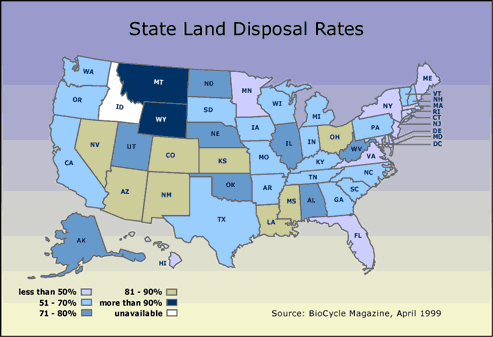
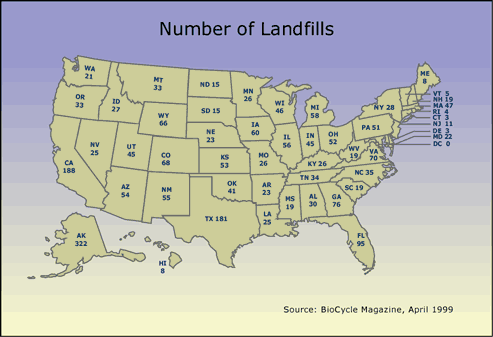
LANDFILL LOCATIONS: Use TerraServer to locate Areas of Interest from Satellite Photos!
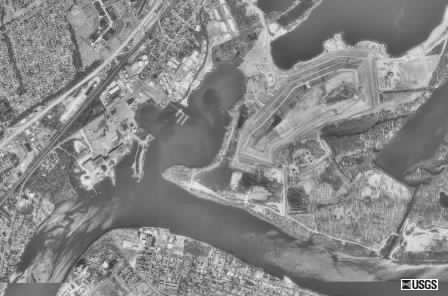
TULLYTOWN LANDFILL (terraced features, northeast of
center) On the Delaware River, Tullytown, Bucks County, PA. View
this area on Terra Server.